 Fully Licensed and Insured
 Request an Oil Tank Scan
 Request a Free Estimate

 Fully Licensed and InsuredRequest an Oil Tank ScanRequest a Free Estimate
Finding an old, buried oil tank on your property isn’t just about curiosity – it’s about peace of mind. Whether you are buying a new home or planning a renovation, knowing exactly what’s under your grass is essential for avoiding environmental headaches and unexpected costs.
In British Columbia, many older homes transitioned from oil heat to natural gas decades ago. Sometimes, the old tanks were simply left behind. At West Coast Tank Recovery, we’ve seen how these hidden “ghost tanks” can cause stress during property sales. But don’t worry; locating them is a straightforward process when you have the right help.
If you suspect there’s a tank on your lot, you might first look for “clues” on the surface. Check your basement or crawl space for copper lines sticking through the foundation wall. Outside, look for a stray filler pipe or a vent pipe near the house. However, these pipes are often cut off or paved over during landscaping, making them impossible to find with the naked eye.
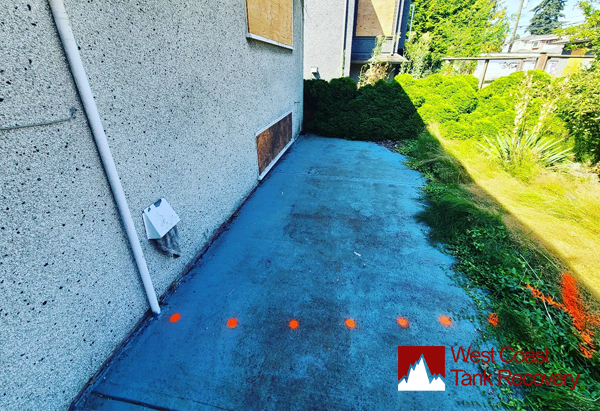
The most reliable way to find the exact position is through a professional scan. We don’t just dig holes and hope for the best. Instead, we use a systematic approach, sweeping the entire perimeter of the home and any areas where a tank might logically be buried. This ensures that even if the surface pipes are long gone, the heavy metal of the tank itself is detected.
Locating a buried metal object requires more than just a simple hardware-store metal detector. To provide a truly accurate “clean” scan, we use industrial-grade equipment designed to see through several feet of soil, concrete, and debris.
The two main tools in our kit are:
By combining these tools, we can distinguish between a buried oil tank and small bits of “trash” metal like old nails or discarded pipes.
A common question we get is, “If it’s there, why can’t I see it?” Most residential oil tanks in our area are buried between two and four feet (about 60 to 120 cm) below the surface.
However, over the years, landscaping changes can bury them even deeper. We’ve found tanks under added layers of topsoil, new garden beds, and even beneath concrete patios or asphalt driveways. Because they are deep enough to be out of sight but shallow enough to potentially leak into the surrounding soil, finding them early is key to preventing a small problem from becoming a big one.
Dealing with a potential oil tank doesn’t have to be a nightmare. It’s simply a box that needs to be checked to ensure your property is safe and compliant with local regulations. Our team at West Coast Tank Recovery focuses on providing clear, honest answers and efficient service so you can get back to enjoying your home.
If you’re worried about a hidden tank or just need a certificate of scan for a real estate deal, we’ve got you covered. West Coast Tank Recovery makes the process easy, professional, and completely stress-free.