 Fully Licensed and Insured
 Request an Oil Tank Scan
 Request a Free Estimate

 Fully Licensed and InsuredRequest an Oil Tank ScanRequest a Free Estimate
What lies beneath the surface of an older property is often a mystery. Across British Columbia, thousands of homes built before the late 1970s relied on underground heating oil tanks for furnace fuel. When properties transitioned to natural gas, many of these metal tanks were simply disconnected, left in the soil, and forgotten.
Decades later, locating an abandoned underground storage tank (UST) is a critical priority for homeowners, prospective buyers, and real estate professionals. Utilizing ground-penetrating radar represents the most accurate, non-destructive method for pinpointing buried tanks without tearing up lawns, driveways, or gardens.
Residential heating oil tanks were typically constructed from bare steel. Over decades of contact with moist coastal soil, steel inevitably corrodes from the outside in.
A corroded tank will eventually collapse or leak residual petroleum sludge into surrounding soil and groundwater. Under the British Columbia Environmental Management Act, the current property owner is legally and financially responsible for remediating environmental contamination, regardless of who installed the tank. In addition, mortgage lenders and insurance underwriters routinely deny financing or coverage on properties lacking verified confirmation of tank status.
Ground Penetrating Radar (GPR) is an advanced geophysical scanning technology that maps subsurface structures using electromagnetic energy.
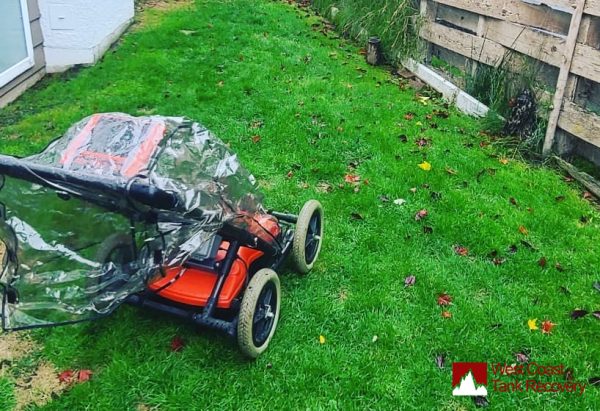
A technician guides a specialized GPR antenna systematically across the ground in a grid pattern. The device emits high-frequency radio pulses into the earth. As these electromagnetic waves travel through the soil, they encounter boundaries between different materials, such as the transition from native soil to dense steel, hollow voids, concrete slabs, or disturbed backfill.
Each material possesses a distinct dielectric property that reflects a portion of the radio wave back to the receiver antenna. The unit records the amplitude and travel time of these reflected signals, instantly converting the data into a real-time cross-sectional profile on the operator’s monitor.
In the past, simple metal detectors or magnetic locators were commonly used to search for buried tanks. While useful in open areas, magnetic tools have severe practical limitations:
Metal detectors respond exclusively to ferrous materials. If an old tank was removed years ago, a metal detector will register nothing. In contrast, GPR detects the disturbed excavation trench, backfill variations, and physical soil density anomalies, proving whether a tank was extracted or left behind.
Metal detectors struggle when scanning over reinforced concrete because embedded steel rebar triggers continuous false positive signals. A calibrated ground-penetrating radar system penetrates through concrete driveways, asphalt pads, and patio pavers, clearly distinguishing the distinct hyperbolic signature of a large cylindrical tank beneath the slab.
Buried utility conduits, discarded construction debris, iron-rich mineral pockets, and cast-iron plumbing pipes often confuse magnetic detectors. GPR provides spatial mapping, depth calibration (up to 10 feet deep), and physical geometry, allowing experienced operators to identify the exact dimensions and depth of a fuel tank with high confidence.
A thorough oil tank scan begins with a visual exterior survey. Technicians inspect the foundation perimeter for historical clues:
The technician then conducts an exhaustive GPR grid scan covering the entire perimeter, side yards, front lawn, and paved driveway. Once the scan is complete, the findings are compiled into an official inspection report. If no anomalies are detected, the company issues an official Oil Tank Scan Certificate (often called a “No Tank Certificate”) that satisfies real estate purchase subjects, mortgage approvals, and home insurance requirements.
West Coast Tank Recovery specializes in non-invasive GPR subsurface scanning, tank extraction, and environmental soil remediation across Metro Vancouver, the North Shore, and the Fraser Valley. With over 17 years of hands-on experience, BBB A+ accreditation, and a Best Price Guarantee, their team delivers fast, certified peace of mind. Property owners and buyers can contact their North Vancouver office at (604) 628-8786 or toll-free at 1-844-OIL-TANK to book an inspection.