 Fully Licensed and Insured
 Request an Oil Tank Scan
 Request a Free Estimate

 Fully Licensed and InsuredRequest an Oil Tank ScanRequest a Free Estimate
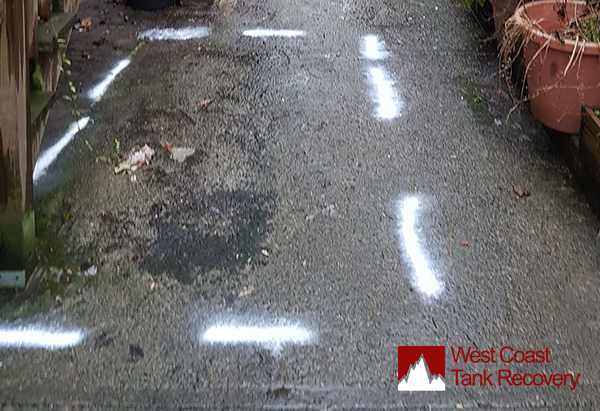
If you are a homeowner in British Columbia, you might be standing in your backyard right now, looking at the grass and wondering what is buried beneath it.
Maybe you saw an old vent pipe. Maybe a neighbor mentioned that your street used to be heated by oil.
Either way, you’ve probably heard that the best way to find out for sure is to use Ground Penetrating Radar (GPR). But before you book a scan, you likely want to know: how accurate is ground penetrating radar when it comes to finding a tank that’s been hidden for fifty years?
The truth is, GPR is the gold standard for a reason, but its precision depends heavily on the type of dirt sitting on your property.
GPR works by sending radio waves into the ground. When those waves hit something – like a big metal oil tank – they bounce back to the surface. The machine then builds a picture based on those bounces.
In a perfect world, that picture is crystal clear. But we don’t live in a perfect world; we live in the Lower Mainland. And our soil can be a bit of a mixed bag.
If your home is in an area with sandy, well-drained soil, you are in luck. Radio waves love sand.
They can travel through it quickly and bounce back with a very sharp image. In these conditions, a technician can often tell you exactly where the tank starts, where it ends, and how deep it is, down to a few centimeters.
If you have sandy soil, the answer to how accurate is ground penetrating radar is: very. It’s almost like looking through a window.
Now, let’s talk about clay. A lot of properties in the Fraser Valley and parts of Greater Vancouver are sitting on thick, heavy clay.
Clay is a challenge for GPR. Why? Because clay holds onto water. And water, especially when mixed with the minerals in clay, acts like a sponge for radio waves.
Instead of the signal traveling down to the tank and bouncing back, the clay soaks up the signal. This can make the image on the screen look blurry or noisy. An amateur might look at that screen and see nothing, while a pro has to work much harder to find the pattern of a buried tank.
Because the soil changes from one block to the next, the machine is only half of the equation. The person holding the radar is the other half.
A high-value GPR scan isn’t just about the technology; it’s about the interpretation. In clay-heavy areas, a skilled technician knows how to adjust the frequency of the radar to punch through the muck and find the target.
They aren’t just looking for a tank shape; they are looking for disturbed soil. When a tank was buried decades ago, the ground was dug up and then filled back in. That change in soil density shows up on the radar, even if the tank itself is hard to see.
The goal of a scan isn’t just to say “there is a tank here.” It’s to prevent you from digging up your entire yard or hitting a gas line.
Precision matters because it saves you money on excavation. If we can tell you exactly where the fill and vent pipes are, the removal crew can work faster and with less mess.
At the end of the day, you want a definitive answer so you can move on with your life, sell your home, or get your insurance renewed.
While the soil on your property plays a big role in the results, knowing how accurate is ground penetrating radar helps you understand the report you get back. Even in tough clay, a professional scan is significantly more reliable than just guessing where to dig.
Don’t leave your property’s safety to chance or a cheap metal detector. If you need to know for sure what’s under your feet, contact West Coast Tank Recovery today. We use the latest GPR technology and have the local experience to read BC’s unique soil, giving you the most accurate picture possible before the shovels hit the dirt.