 Fully Licensed and Insured
 Request an Oil Tank Scan
 Request a Free Estimate

 Fully Licensed and InsuredRequest an Oil Tank ScanRequest a Free Estimate
A property in Burnaby sold conditionally two years ago pending an oil tank scan. The scan found a buried tank the sellers had no knowledge of. The deal sat in uncertainty for weeks while the tank was removed and the surrounding soil assessed. Situations like that play out regularly in neighborhoods built before the 1970s, when oil heating was standard across Metro Vancouver.
Professional oil tank recovery is not a simple excavation job. It is a regulated process with environmental consequences if handled carelessly, and real legal exposure for property owners if it is not done correctly or fully documented.
Ground penetrating radar, or GPR, is the detection method used by professional oil tank recovery companies. A GPR unit sends electromagnetic pulses into the ground and reads the reflected signals to identify buried objects. A trained operator can locate a tank beneath concrete, asphalt, or soil without excavating anything.
GPR scanning is non-destructive and takes a few hours for a standard residential lot. The output is a scan report that documents what was found, where, and at what depth. This report matters for real estate transactions, municipal permits, and insurance purposes.
Some property owners try to skip the scan and go straight to excavation based on a visual clue, an old fill pipe on an exterior wall, a patch in the driveway over a known location. That shortcut occasionally works. More often it results in either missing a tank or digging in the wrong spot and creating a larger, messier, and more expensive situation.
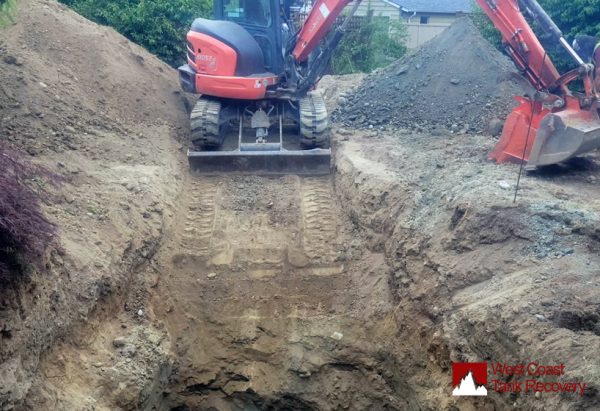
Once a tank is located, the removal begins with excavation around the tank perimeter. For underground storage tanks, this typically means removing 3 to 5 feet of soil above and around the tank body, depending on burial depth. For tanks buried under driveways or patios, the surface material needs to come up first.
The tank is then pumped out if any residual oil or sludge remains, cleaned, and cut for safe transport. Intact tanks are not transported full. An oil tank removal company manages disposal of residual material according to environmental regulations.
Above-ground storage tanks follow a similar process without the excavation, though older tanks can have significant corrosion that complicates safe handling. Commercial oil tank removal involves larger volumes and additional site coordination but follows the same regulated process.
Documentation at each stage is essential. A reputable contractor provides written records of the tank’s condition, the removal process, and how the residual material was disposed of. That paper trail protects the property owner.
Removing the tank is only half the work. The soil around any buried tank needs to be tested for petroleum hydrocarbon contamination. Even tanks that appear structurally intact can have leaked slowly over decades through corroded joints or seams.
Soil testing for oil leaks involves taking core samples from the excavated area at specified depths and submitting them for laboratory analysis. Results are measured in parts per million of total petroleum hydrocarbons. BC environmental regulations set specific thresholds that determine whether the site is clean or requires further action.
Results below the threshold mean the site is clear and the excavation can be backfilled and restored. Results above the threshold trigger remediation requirements. Knowing this before you close an excavation is critical. Backfilling a contaminated site and discovering the contamination later is far more expensive to address.
Soil remediation in the context of oil tank removal means excavating and removing contaminated soil from the site and replacing it with clean fill. The volume of contaminated material removed depends on how far the hydrocarbon plume has spread, which the testing process defines.
Contaminated soil is transported to a licensed receiving facility. The replacement fill is documented as clean. Once backfilling is complete, follow-up testing confirms the site meets the required standard. That confirmation is what generates the closure report, the document that closes the environmental file on the property.
This process takes time. Depending on the extent of contamination, soil remediation can take anywhere from a few days to several weeks. Knowing that timeline upfront avoids surprises, especially if a property sale is contingent on a clean environmental report.
At West Coast Tank Recovery, we have been handling professional oil tank recovery in Vancouver and the Lower Mainland since 2007. We provide GPR scanning, underground and above-ground tank removal, soil testing, and contamination remediation from start to finish. If you have a tank on your property or need a scan before a sale, call us at (604) 628-8786 for a free estimate.
Stay Updated: Get reliable oil tank removal guides, property compliance tips, and soil testing insights directly on Google. Click here to prefer WC Tank Recovery on Google.