 Fully Licensed and Insured
 Request an Oil Tank Scan
 Request a Free Estimate

 Fully Licensed and InsuredRequest an Oil Tank ScanRequest a Free Estimate
Purchasing a home is one of the biggest financial decisions you’ll ever make. So it only makes sense that before you seal the deal, you find out everything you possibly can about the property you’re about to purchase.
A home inspection is a very common clause in an offer to purchase agreement. During this inspection, a qualified contractor will examine the structure and foundation, as well as inspect the electrical systems and plumbing for any issues.
However, home inspections overlook one very important detail. Most Vancouver houses built before 1970 contain underground oil tanks. And while many of these tanks have since been removed, those that remain pose a significant risk to the environment, community health and safety, and your finances. It’s for these reasons that GPR tank locating should be a part of any pre-purchase home inspection.
Before transitioning to other fuel sources, most homes in Vancouver used oil for heating. And to store this fuel, residents would bury fuel tanks in their backyards. In the years since, natural gas and electricity have replaced oil as the primary heating sources in Vancouver, and these tanks were forgotten. However, many of them are still buried beneath grass and driveways.
These large metal drums have a finite life expectancy, which has long since expired. Those that remain buried are slowly deteriorating and risk leaking harmful chemicals into the soil and nearby groundwater.
Unfortunately, these leaks are not only hazardous to people and the environment, but they can also be highly complex and costly to remediate. As the new owner of the property that is found to have an underground oil tank, you could have a major problem.
Because when it comes to financial responsibility for removing the tank and any remediation requirements, whether the tank was uncovered before or after the sale is important. If the tank was known before closing, the sellers could be liable for all costs associated with the tank; if it was discovered after closing, the expense could fall on you.
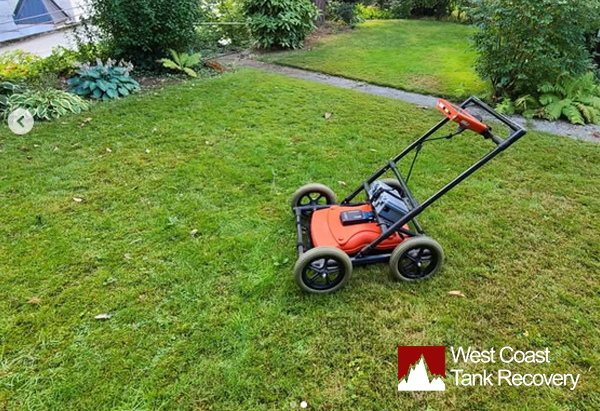
GPR stands for ground penetrating radar. It is a non-invasive scanning technology that emits radar pulses to scan below ground level. During home inspections, GPR tank location allows experts to find underground oil tanks without digging or causing harm to the property.
Radar technology generates pictures that readily show underground abnormalities, such as metal tanks. This is safe, quick, and highly accurate. It provides sellers and buyers with confidence by confirming whether a tank is on the premises.
Problems hiding underground can lead to a great deal of stress and added expense when purchasing a new home. A leaking underground storage tank could require remedial action at significant cost. Even if it’s not leaking, the city may require you to remove it.
Adding GPR tank locating as a component of a pre-purchase inspection is a smart move for any prospective homebuyer. If a tank is found, they can negotiate the cost of removal into the contract or require the sellers to remove it before closing. If there’s no tank, customers can rest easy that their investment is safe. Either way, it is about honesty and avoiding nasty surprises when moving in.
An underground oil tank can impact the value of your home due to the risks it poses. Buyers can decide to walk away from a purchase, and often, lenders won’t extend mortgages to properties with unresolved underground tanks. Proactively locating tanks using GPR tank locating preserves the long-term property value for homeowners.
It also favours the sellers. Having an available tank locating report is a good-faith gesture and instills confidence in the prospective buyer. It sends a signal that the property has been thoroughly inspected and that no surprises are lurking underground.
Another reason to consider using GPR tank location is to protect the environment. Leaking oil tanks pose a serious risk to the ground and water. Cleanup is expensive and disruptive to the property. In some cases, government officials may become involved, which can add to the stress and increase the cost.
Using GPR to check the status of any underground oil tank gives homeowners and purchasers peace of mind, preventing future damage and costly liabilities.
Not all inspections include this professional service. Standard house inspectors will usually inspect easily visible and accessible systems within the house. To enable a thorough evaluation, it is essential to use a firm that offers professional GPR tank locating services.
Licensed professionals utilize the most advanced radar technology to scan the property quickly and efficiently. Their training enables them to gather and interpret scan results, determining whether a disruption is caused by an underground tank or something else. Their expert report provides homeowners with the necessary documents for real estate transactions or municipal compliance.
Is GPR safe for my property?
Yes, ground penetrating radar is entirely non-invasive. It does not degrade or destroy the land.
How long is a GPR tank locating scan?
Most GPR scans can be completed in a few hours.
Can a typical home inspection find oil tanks?
Standard home inspections won’t detect underground tanks. Specialized equipment and training are needed to obtain accurate results.
Who pays for a tank removal if it is found?
Responsibility is dependent upon when the tank is found. When a tank is discovered before the purchase has been completed, buyers can negotiate with the seller. When found after selling, a new owner can be held accountable.
Why is GPR better than other techniques?
GPR is accurate, efficient, and does not damage property. Other techniques can include digging, which is costly and destructive.
Including GPR tank locating in a pre-purchase home inspection is the smartest thing any buyer can do. It protects against financial loss, preserves property value, ensures environmental safety, and provides peace of mind. For professional GPR tank locating in Vancouver, turn to the experts at West Coast Tank Recovery, Vancouver’s leading provider.