 Fully Licensed and Insured
 Request an Oil Tank Scan
 Request a Free Estimate

 Fully Licensed and InsuredRequest an Oil Tank ScanRequest a Free Estimate
If you are buying or selling a home in British Columbia, you already know the real estate market moves fast. But nothing stops a deal in its tracks quite like the mention of a buried oil tank. In cities like Vancouver, Burnaby, or Victoria, these “hidden ghosts” are everywhere. Most were installed decades ago and then simply forgotten when homes switched to natural gas.
The problem is that if you own a property with a buried tank, you own the liability. If it leaks, you are responsible for the cleanup costs – which can easily reach six figures. That is why professional oil tank scanning is your best friend when it’s time to sign on the dotted line. At WC Tank Recovery, we’ve seen how a simple scan can save a homeowner from a total financial disaster.
We often get asked if a scan is just a guy walking around with a metal detector. Not even close. A professional oil tank scanning service is a thorough investigation of the property. When we arrive, we don’t just look at the backyard. We check for “clues” first – things like old filler pipes, vent pipes, or even patched holes in the basement concrete where oil lines once lived.
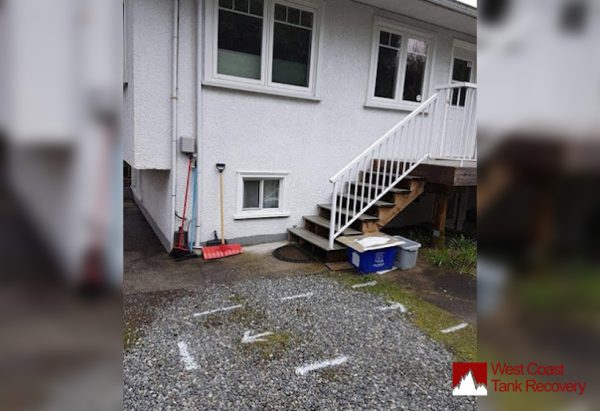
Once we’ve done our visual check, we use high-tech equipment to “see” under the surface. We scan the entire yard, focusing on areas near the foundation where tanks were traditionally buried. We also check under decks, patios, and even driveways. If we find something, we mark the exact location and depth. Finally, we provide you with a written report and a certificate of compliance if the site is clear. It’s a fast process, but it’s incredibly detailed.
In the old days, contractors used simple magnetometers. Those are basically glorified magnets. The trouble is, they go off for every old nail, buried pipe, or scrap of rebar in the soil. They are notorious for giving “false positives.”
This is why we use Ground Penetrating Radar (GPR). It is the most effective tool available today. GPR works by sending radio waves into the ground that bounce back when they hit an object. It allows us to see the actual shape and size of what’s down there.
GPR is so precise it can tell the difference between a rock and a 500-gallon steel tank. It works through soil, grass, and even thick concrete. For us, using GPR is about giving you 100% certainty. In the BC real estate market, “pretty sure” isn’t good enough when your house is on the line.
While a scan is great for finding the tank, it also gives us vital clues about what’s happening underground. An oil tank scanning session tells us the exact dimensions of the tank and how deep it is buried. This is crucial for planning a safe removal without damaging your home’s foundation or underground utilities.
While the scan itself doesn’t “see” inside the metal, our GPR can often detect “disturbed” soil around the tank. If a tank has been leaking, the soil density changes, and the radar can sometimes pick up on those anomalies. It helps us prepare for whether we are doing a “dry” pull or if we need to start talking about soil remediation.
Whether you are a buyer trying to avoid a money pit or a seller looking to provide a clean disclosure, you shouldn’t skip this step. A professional scan is a small price to pay for total peace of mind.
At WC Tank Recovery, we live and work in your neighbourhood. We know exactly what to look for and how to help you navigate the BC environmental laws. Don’t let a hidden tank become a legal nightmare. Give us a shout today, and let’s make sure your property is safe, clear, and ready for the future.